
 YouTube
 Apple Podcasts
 Spotify
 iHeartRadio
 The Psychology of Employee Motivation - with Dr Bob Nelson & Mario Tamayo (Ep. 107)
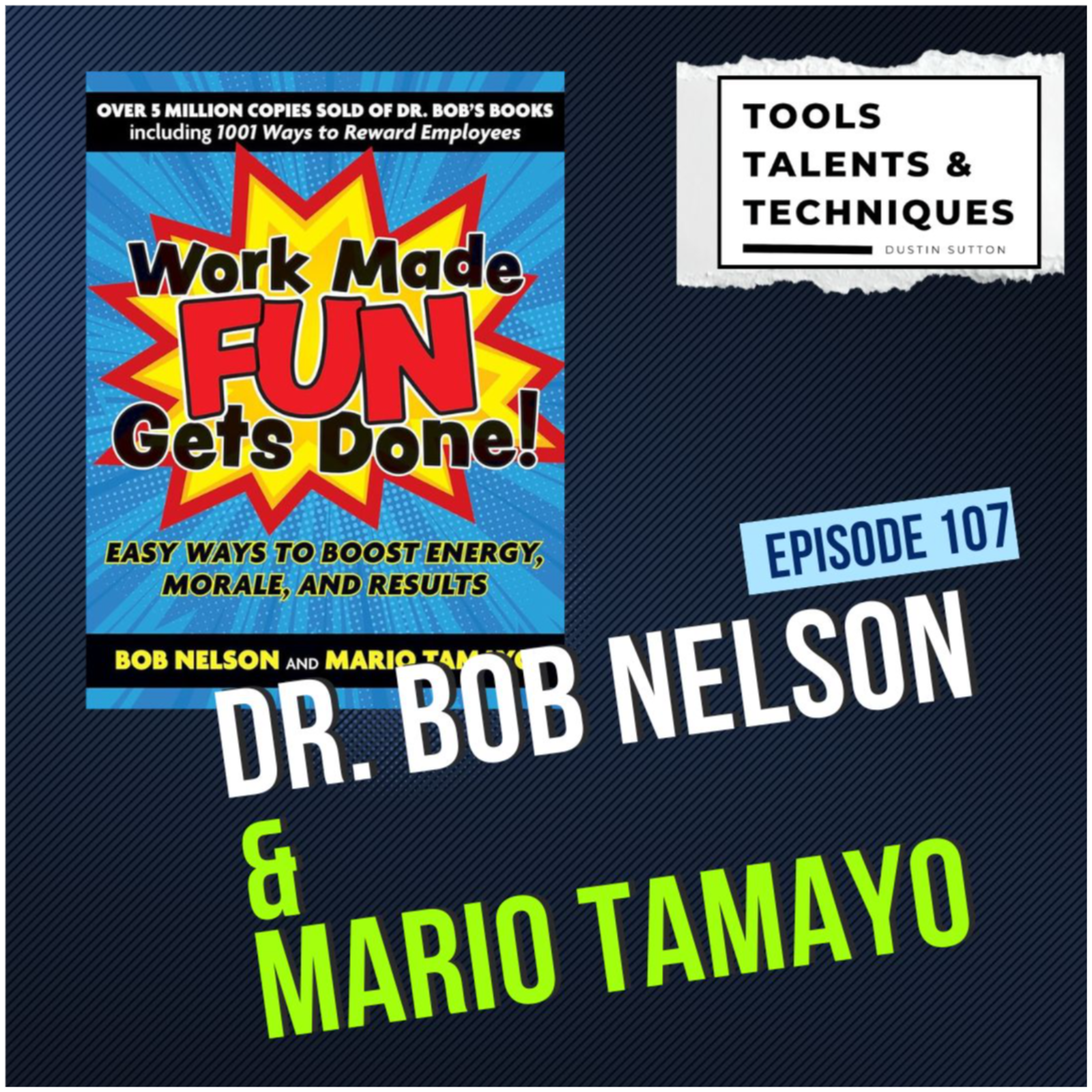
Most managers think they are recognizing their employees. Most employees disagree. That gap is costing organizations more than they realize.In this episode, Dustin sits down with Dr. Bob Nelson, recognized as the number one management guru in the world three years running, and Mario Tamayo of the Tamayo Group to break down why employee recognition is one of the most underutilized tools in leadership and exactly what to do about it.Together they unpack the disconnect between how managers perceive their own recognition efforts and what employees actually experience, why personalized recognition outperforms generic rewards every time, and how leaders can build cultures where people genuinely want to show up and contribute.If you manage a team of any size this episode gives you practical tools you can use immediately.
Employee recognition and leadership are two of the most important drivers of employee engagement and workplace culture. In this episode of Tools, Talents & Techniques, Dustin Sutton sits down with management expert Dr. Bob Nelson and leadership advisor Mario Tamayo to discuss how meaningful recognition improves motivation, performance, and team loyalty.
Dr. Bob Nelson, named the #1 management guru in the world for three consecutive years, shares research-backed leadership strategies that help organizations build stronger cultures and more engaged employees. Together with Mario Tamayo, the conversation explores the disconnect between how managers believe they recognize employees and how employees actually experience recognition in the workplace.
Key Topics Covered
• Why employee recognition is critical for engagement and performance
• The disconnect between managers’ perception of recognition and employees’ experiences
• How personalized recognition creates stronger motivation than generic rewards
• Practical techniques leaders can use to recognize and encourage employees
• The importance of hiring for cultural fit and long-term potential
• Why learning from mistakes is essential for growth and development
• How leadership influences workplace culture and morale
• The role of soft skills in modern management
Learn More About Our Guests
Dr. Bob Nelson https://drbobnelson.com/
Mario Tamayo https://www.tamayogroup.com/
YouTube https://youtube.com/@dustincsutton
Apple Podcasts https://podcasts.apple.com/us/podcast/tools-talents-and-techniques-with-dustin-sutton/id1692838507
Spotify https://open.spotify.com/show/7pQZ551Ct4jVRQ2BqB7Zr2?si=740ba4a90165417a
Follow the Podcast
Instagram https://www.instagram.com/the3tpod/
X https://twitter.com/the3tpod
Music provided by C€$ on Spotify https://open.spotify.com/artist/21zXwxV9nWaiE6iAleU6ww?si=yNBmIPqIT7-56hAmfvqShA
#Leadership #EmployeeRecognition #Management
Mario Tamayo (00:00.061)
Thanks for
Dustin Sutton (00:00.94)
Yeah, yeah, I can take off the beginning or if it sounds good, we can keep going. So yeah, I edit it. I do all that. So we're good. Yeah.
Mario Tamayo (00:07.738)
Okay, all right.
Dr Bob Nelson (00:08.535)
Well, just this morning I was notified that I've been named the number one management guru in the world for the third consecutive year.
Dustin Sutton (00:20.621)
What?
Mario Tamayo (00:20.867)
Wow, wow and Bob and Bob, your cousin was your cousin the one that voted for you
Dr Bob Nelson (00:28.612)
Yeah, all three votes came in. But that's above the next three or four people are from Teach at Harvard Business School and et cetera. But kind of fun.
Dustin Sutton (00:29.318)
Ha
Mario Tamayo (00:32.413)
You
Dustin Sutton (00:33.152)
Hahaha!
Mario Tamayo (00:35.452)
Yeah
Mario Tamayo (00:42.109)
Wow, man.
Dustin Sutton (00:43.97)
Yeah, congratulations. so also, before we started recording, Mario, you said that Dr. Bob is, what did you say he was? The guru?
Mario Tamayo (00:53.841)
I said in the business world he is known as the Guru of Thank You.
Dustin Sutton (00:59.084)
Dr. Bob, did that come from? Who did you think that that became the cure? Thank you.
Mario Tamayo (01:03.494)
AHAHAHAHA!
Dr Bob Nelson (01:06.178)
I don't recall, but I got, I got, yeah, I've been to some magazine covers and sometimes I come up with fun stuff like that.
Dustin Sutton (01:16.449)
Okay, well listen.
Mario Tamayo (01:17.245)
Well, he was on CNN and all these other top TV shows and all. 60 minutes, 60 minutes.
Dr Bob Nelson (01:23.876)
That... That
Mario Tamayo (01:28.22)
You
Dustin Sutton (01:28.408)
So that's one of the things that, so before we go any further, I want to give you guys an opportunity to, we jumped right into the fun stuff, but I want to give you the opportunity to introduce yourselves and a little bit about, there's just a quick snapshot of who you are and then we'll get into the details of everything else. So Dr. Bob, would you please let our audience know who is this guru of thank yous?
Dr Bob Nelson (01:53.892)
That is I. I've kind of devoted my career to helping managers better engage their employees, better motivate their employees, which really comes down to kind of common sense. Treat them well. If you don't want your spouse to be a nag,
treat it like a thoroughbred, know? And a version of that for employees as well. If you treat them like they're important to you, they're going to return the favor.
Dustin Sutton (02:35.574)
And so you're an author, you're a very distinguished author and you've written several books. Could you just briefly talk about that?
Dr Bob Nelson (02:43.812)
Sure, yes, it's my journey. I'm just completing my 32nd book, A Thousand One Ways to Grow Employees. be out later this year. And it just went into production. And I'm probably most known for A Thousand and One Ways to Reward Employees. It came out 30 years ago and is now in its 66th printing. It sold about two million copies. I've sold five million books overall for my different titles.
Dustin Sutton (03:11.832)
Amazing. And so the way I was introduced to you was our other guest is Mario Tamayo.
Dr Bob Nelson (03:18.308)
That did it.
Mario Tamayo (03:20.029)
That would be me.
Dustin Sutton (03:24.568)
So Mario, could you please briefly introduce yourself?
Mario Tamayo (03:28.251)
Yeah, at one point I worked for Bob. Bob was vice president of product development for the Ken Blanchard companies. And Bob was a top executive there with the company. And I was the director of product development. And my team was able to create over 250
Dr Bob Nelson (03:35.256)
You don't still?
Mario Tamayo (03:58.523)
leadership resources that are still in use today. And that includes things like situational leadership and building high performing teams and, legendary and raving fan service among others. I worked for many years for them and then I went off on my own and have been working as a coach and, as a consultant and Bob, just a couple of years ago. Actually, Bob is five years ago now.
Dr Bob Nelson (04:28.098)
Really?
Mario Tamayo (04:28.861)
Bob invited me to be a co-author of his and we wrote a really, really fun book. In fact, we had fun in the title and there it is. made fun, it gets done.
Dr Bob Nelson (04:41.956)
400 specific real-life examples of how you can make any task or group activity or more fun and what you can do as an organization to make that part of what it means to work here.
Mario Tamayo (04:54.671)
And those are, those were tips and, and, processes and procedures that were volunteered voluntarily shared with us from public and private sector companies, from government and educational agencies, international mom and pop organizations, and all of it points to one thing. And Bob was alluding to that earlier. And it's really probably the one minute, I mean, the, the, top
a leadership management principle of all time and it has to do with what gets recognized. Bob, forgot.
Dr Bob Nelson (05:31.352)
gets repeated, gets rewarded. So again, if you treat employees well, they will reciprocate. Whereas as Walt Disney said, he was young in his career, had an epiphany. He said, if I ever get chance to manage people, will treat them as I'd like to be managed, that if I treat them like they're my customer, they will treat our
company's customer the same way. And that's really the foundation of Disney's success over the 55 years they've been in existence.
Mario Tamayo (06:06.117)
And Bob and I took that one step further because as Bob mentioned that most people know what the golden rule is, know, do unto others the way I want to be done unto, roughly paraphrased. But Bob and I, we subscribe to something that we think is even greater. It's called the platinum rule. And it's basically the same thing as the golden rule, except for two words. And the two words are do unto others.
Dustin Sutton (06:15.544)
Sure. Sure.
Mario Tamayo (06:35.505)
the way they need to be done unto. And so we look at, as we look at what does a person need? Not what I need. If I'm going to serve somebody, I'm going to do what they need, not necessarily what I need. Because what I need may miss the boat with other people.
Dustin Sutton (06:57.65)
Let's explore this a little deeper because especially we're talking about managers and leadership. How does one go about those folks determining what other folks need?
Dr Bob Nelson (07:12.676)
Well, that's very common with managers. when they think to motivate their employees, they think what would motivate them. And they're in a different stage in their career, different circumstances. so it's better to just start with what does the employee want? So by talking to them, by asking them, by getting to know them, you can anticipate what things would be helpful for them, knowing that for most every employee, they're looking to
Mario Tamayo (07:13.169)
Bob.
Dr Bob Nelson (07:42.628)
get ahead and advance and support themselves, their family, better enjoy life. So that's kind of a fundamental, but within that context, as you get to know people and ask them their preferences for being recognized and the things that are going on in their life, do any family, have any kids, what are their kids' names, have any pets, what are their pets' names.
What's their favorite food, favorite flower? The more you know about someone, the more fodder you have to motivate them. Not to manipulate them, not to trick them into working harder, but actually to sincerely help them on their journey, which then they will reciprocate and want the manager to be successful as well. Because if you have a good manager, it's only one out of every four or five managers you'll have in your career that you'll think is a good manager.
So when you get one, you want to hold on to them. And you think twice or three times about leaving because the next person is likely to be a jerk. And so there's a real resilience that comes from doing this common sense behavior of treating people right.
Mario Tamayo (08:51.727)
You
Dustin Sutton (09:00.449)
And so
Mario Tamayo (09:00.541)
There's three basic reasons why people leave their organization. Number one is they're not getting enough recognition. They're not being valued for who they are. Number two is their boss. They don't quit companies, they quit bosses. And then the third one is they're not getting enough career development. And if we take care of those three things, then you're gonna have a standout organization.
Dustin Sutton (09:24.77)
Hmm. Yeah. So, yeah, well, my question is, I actually have several questions. One of my questions is when you talk about determining what that person needs, and you alluded to what that employee wants, where I could, and all, wait.
Dr Bob Nelson (09:25.516)
Yes, and creative good
Mario Tamayo (09:43.997)
What they need not what they won't necessarily want because sometimes yeah
Dustin Sutton (09:49.443)
Yeah, and that's what I'm saying. Like what they need, because I'm talking about like some people need a little more structure. Some people need a little more room for creativity. what you said, Dr. Rob, what you said about, you know, especially, you know, talking about what the person's favorite color food, know, pet's name, all those things. And certain people that are in leadership roles don't necessarily always have that high EQ.
where they are genuinely interested in those things. And it's like, is that something that comes up in teaching and coaching of how to increase that?
Mario Tamayo (10:19.197)
Yeah.
Mario Tamayo (10:24.029)
Ha!
Dr Bob Nelson (10:27.876)
Absolutely. It's sort of like, well, if that's the case, and if you're not inclined this way, then you got maybe have someone on your team that does it for you, or you got to, you know, at least try something. It doesn't have to be, there's no one answer. So, give you example, I was working with a CEO in Manhattan and actually having a beer with him. And he said, Bob, I just can't.
praise people to their face. It's not who I am. Well, that's too bad, but you don't have to praise someone to their face. You do have to do something, So let's talk about, let's look at the book here and let's talk about what you might consider doing. Excuse me, guy coughed. Pardon. But, and he came up with, he was going to start, was the CEO of this company for 25 years. He'd never done it. Basically started having a breakfast once a month.
and invite one person from each department to attend. And he did the first one and they had an open agenda. They just went around. Everyone talked about something they're excited about in their job, including him. And he did one of those means because I can't believe I haven't been doing this. He learned so much about his own company. And for every employee that came, they immediately, you know, guess who I had breakfast with to their spouse or significant other. you know, things are happening, you know, and over the course of the year, he had
FaceTime with every employee and just help to bring the cutting a little bit tighter together and allow people to get to know each other about things that they're excited about at work.
Dustin Sutton (12:06.926)
And open up that line of communication too. maybe it's, again, I'm assuming based on what you said is that.
Mario Tamayo (12:07.037)
Now Dr. Blob
Dr Bob Nelson (12:12.548)
Yeah, meet someone you didn't know and now you've got someone in county you can ask a question to and you just bring a tighter team working towards the same goals.
Mario Tamayo (12:25.329)
Now Bob did some research years ago and there was a stark difference between what employees said, how much recognition that they get and how much they want to how much managers thought they were giving. Bob, do remember that?
Dr Bob Nelson (12:39.524)
Yeah, yeah, kind of classic study actually was initially done in 1949 by Lawrence Lindell. And it just very simple. I think the best research is very simple. What do employees want? And they had a list of 10 things. And they asked managers, what do you think of this list that employees want? And they said, well, of course, they want more money and they want benefits and job promotions. Those are top things.
Then they took the same list and asked employees, what are these lists you most want? And they didn't say any of those things. They said they wanted a sympathetic ear listening. They wanted to be recognized when they do good work. And they wanted a chance to grow and learn. none of those things cost any money. Other things cost a lot of money. And wow, maybe if we focus on those, we'll be farther along.
And so the irony, which I've always been amazed at, is that the things that have the most value to employees typically have the least cost. It just takes a little time, a little thoughtfulness, but you don't have to have a big budget to make this happen. So when I work with smaller companies, they say, we don't have a budget to motivate people, i.e. we can't pay people more. I go, well, why don't we look at
Let's take inventory of what you do have. You got daily contact with people, you got access to top management, you're not rule bound by a 300 page policy manual. This afternoon to celebrate you can go do a popcorn lunch. Right Mario? We did a few of those. We can go to the movie together. What you guys want to see? I'm buying popcorn for everybody.
Mario Tamayo (14:26.717)
I have to tell you one year when Jurassic Park came out, remember the movie? This was way before you were born, Dustin. Jurassic Park came out and we decided, you know what, we should take our whole department out to lunch and then go to the movie. And what we said was, we're gone for the afternoon. We've got a paleontology workshop that we're going to.
Dustin Sutton (14:35.64)
Sure, yeah, okay. Glad you think that.
Dustin Sutton (14:55.702)
Okay, a little bit of a stretch.
Dr Bob Nelson (14:55.748)
you
Mario Tamayo (14:56.389)
We used to do a lot of that kind of stuff and people just loved it. They just absolutely loved it.
Dr Bob Nelson (15:03.176)
And then maybe other employees were jealous of it and I would get heat for having done it. But then you step up to say, you know what? Our team, they deserved it. They earned that. It wasn't just a gimme. was look at the goals we met. Look at the customer satisfaction we have. So we're taking time to notice that, to celebrate it, because we're never too busy to celebrate excellence.
Mario Tamayo (15:30.429)
Let me go back to what Bob was saying about the one CEO who had never really given face-to-face recognition to anybody. what we found was that most employees, I think it was what Bob, 96 % said, they really could use more recognition. And when they talked to the bosses, the bosses, 40 % of them said, well, I do it.
Dustin Sutton (15:42.68)
Sure, please.
Dr Bob Nelson (15:59.109)
Well, actually, 80 % of bosses say, oh, I'm really good at that. And only 12 % of employees say they get meaningful recognition. So it's a big disconnect.
Mario Tamayo (16:02.771)
that's what it was, that's what it was.
Dustin Sutton (16:03.982)
You
Mario Tamayo (16:13.117)
And one of the reasons is, again, is a lot of people feel uncomfortable. They don't have the skillset to give that kind of feedback. found when we were with Blanchard, we found that there's four times as much negative feedback given than positive feedback.
Dr Bob Nelson (16:29.124)
And actually, Gallup has updated that research, Mario. They put it at 6 to 1. Yeah, 6 to 1 is 6.
Mario Tamayo (16:35.643)
It's 6 to 1 now. So what we recommend is, hey, you got to actually take your managers, your leaders by the hand, and you've got to show them what physical and verbal skills, and even writing skills look like when you want to give feedback. And it has to be genuine. And one of the things we had people do is we said, you know what? Put it in your calendar that you're going to get up and walk around and you're going to find people doing the right thing.
Dr Bob Nelson (16:41.75)
you
Dr Bob Nelson (17:03.916)
or start the meeting with some type of recognition. Hey, before we get started, I wanna call out so-and-so finished a project or Mary finished a degree or someone had a birth in their family. Does anyone else have any praisings they wanna call out and have it be a group activity? And if you've never done that, the first time's kinda awkward, but then people get into it and they will remember and things to share and off you go.
Dustin Sutton (17:30.67)
And it compounds, then other people want to do it because it feels good. And it's great to be able to do that. So I that's a great point. And one of the things that you alluded to is it cost you no money. And there's an expression, most important investment is paying attention. And really, that's what it is. It's just paying attention and being aware, listening intently.
Mario Tamayo (17:34.98)
Absolutely.
Mario Tamayo (17:51.729)
Yeah.
Dustin Sutton (17:57.647)
I want to talk a minute about you guys when you started, when you first connected, when you worked together. At the Ken Blanchard Company, was most of the foundation of how you think of things and leadership, was it a part of the company culture at Ken Blanchard? And I think I'm leading this question into a broader question. Like how much did you learn there in the foundation of your formative thinking?
versus how much you've learned the rest of the time being coaches and working with other organizations. I'd love to hear how that gradually evolved.
Dr Bob Nelson (18:36.26)
Sure, obviously Dr. Blanchard was a big influence in both our lives and still is probably. He's very consistent, he's very simple, but it's on the things that matter the most, which I found to be pretty common on great people I've known. Peter Drucker, very simple, very clear, know, managed to get the work done through others.
Mario Tamayo (18:45.873)
yeah. yeah.
Dr Bob Nelson (19:04.6)
being a super worker or I'm a coach for Marshall Goldsmith, the world's number one executive coach and very simple. What he focuses on and relentless on focusing on the simple things that actually make the biggest difference. So on that level, learned a lot from others and tried to integrate those into what I do to help others.
How about you Mario?
Mario Tamayo (19:35.313)
Well, one of the things that Ken is known for is the one minute manager. And Ken's gift was to be able to take a lot of complex subject matter and get it down to two to three secrets. So when he, when he wrote the one minute manager in 1982, was it Bob? Something like that. He had three secrets and it was all about.
Dr Bob Nelson (19:38.68)
Dr Bob Nelson (19:59.247)
Yeah, about that, yeah.
Mario Tamayo (20:04.069)
one minute goal setting, minute praising, and one minute reprimand. He's since changed the reprimand to something different, more palatable. But, you know, I'm getting old myself. Yeah, something like that, or a one minute redirection, I think it was calling. Anyway, so he had the fertile ground there for us. Now I came in from general dynamics,
Dr Bob Nelson (20:13.304)
What does it call that now?
Reframing? Maybe one minute reframing? Yeah.
Dustin Sutton (20:19.081)
Hahaha!
Mario Tamayo (20:33.687)
And I had started, but one of the things Ken would say is catch people doing things right or catch them doing things approximately right if they're new to the task or the goal. And so as a recognition, ahead.
Dr Bob Nelson (20:46.532)
Good thoughts not delivered means squat. He had a bunch of them.
Mario Tamayo (20:52.379)
Yeah, exactly. Yeah. And he's famous for a lot of that. One of the things that I brought in was on this recognition, I brought in an awards process. Now, GD, what we did was we had what we called like a people's choice awards and they're all based on the company values. And we said, we want you to nominate your peers here, nominate anybody in the organization who you find
living out the values.
And when you nominate somebody, if that person wins, then you have right of first refusal to make their award. We're coming up to low or no cost here for awards. And you also have the right of first refusal to deliver the award, to give that person the award. Now, when we first started doing it, we had people just standing and going, that's never going to work. that's hokey.
And the first time we did it.
It was a huge success. I'll give you an example. One person gets up there and she's giving the rookie of the year award, which she made. She took baby shoes and she painted them a certain color and she mounted them and it was beautiful. Well, she was able to tell the story about who the winner was. And she gets up on stage, she shows the award, she explains what the award's for, and then she tells the story behind it. the people who put on the awards were sitting,
Mario Tamayo (22:29.507)
sitting back at the head table. We're looking around to see how people are reacting to this. And so Mary, the person who's giving the award out, she says, so she's telling the story and we're looking around. saying, do you think, do you think Terry knows that it's her yet? And not yet, not yet. And so we're looking around and as Mary gets further into the story, we could see Terry, her face change, her hand or gestures come up.
You can tell that she's realizing that I'm the winner here. Mary finishes, Terry jumps up, she goes up there, they're both crying. They're both crying. Genuine tears for this. She gets the award, she gets a standing O, and the person who says this will never work jumps up and goes, damn, it does work. So we had three to four awards per.
Dustin Sutton (23:22.4)
I'm Eureka.
Dr Bob Nelson (23:26.116)
you
Mario Tamayo (23:28.237)
a company value and people loved it because it wasn't just something that was out of a catalog. wasn't money. It wasn't a check. It wasn't a gift card. was something that had meaning to that one individual person. And what happened over time was people said, I want to win it. I want to win that award. And they started putting it in their goals for the year. I want to win X award for next year. Well,
I took that process, I ran it for six years at General Dynamics, took it to Blanchard and they're still doing it. I introduced it to them in 97 and they're still doing it. So it's a big thing. And that's just, yeah, Blanchard was fertile ground because he cared about people. It was all about servant leadership, which...
Dr Bob Nelson (24:07.565)
Excellent.
Dustin Sutton (24:18.464)
Yeah, well, I love that. This is a big part of the show of tools, talents, and techniques. When you find something that works and like what are the techniques that you use? What are the talents that people have? So are there any other examples that you can give of techniques that people have implemented in their organization? I mean, I know you can.
Mario Tamayo (24:41.117)
Bob has, how many thousand and one ways books do you have, Bob?
Dr Bob Nelson (24:47.14)
Six of them are it, or 1,501 ways to reward employees.
Mario Tamayo (24:50.929)
Well, give them the rest of your titles for the 1001 ways.
Dustin Sutton (24:55.19)
I'll put you on the spot now. Give you all the titles of books that you read.
Dr Bob Nelson (24:58.372)
A Thousand and Ways to Reward Employees, a Thousand and One Rewards and Recognition Field Book, A Thousand and One Ways to Take Initiative at Work, A Thousand and One Ways to Engage Employees, and coming out, A Thousand and One Ways to Grow Employees, which is just going into production with my publisher, HarperCollins.
Mario Tamayo (25:21.917)
And again, most of these ideas, I would say what? 90 % of them are low to no cost.
Dr Bob Nelson (25:29.506)
Yeah, maybe two thirds are no cost, they're all real. They're all actual. I'll add some of my own tips and stuff, but it's probably 90 % is this is what so-and-so is doing. And this is what they said about this, why they did it, here's the results they got, where you have it. But it's all real examples. It's not hyperbole.
Mario Tamayo (25:32.359)
Two thirds, yeah, cause we're.
Dustin Sutton (25:54.478)
Is there... sorry, go ahead Mario.
Mario Tamayo (25:54.757)
And I think that one of the best ways to operationalize these things is we highly recommend this to each manager. We've had it where a company will buy the book for each manager or for each department. And at their meetings, at their weekly meetings, bi-weekly meetings, what they do is they pass the book out and they pass it around. They said, we want you to put your initials next to the things you like to do.
Dr Bob Nelson (26:25.124)
or like to have. So it becomes a personalized handbook for your immediate team. And remember when we worked with the Delmar Fair, Mario, the HR director there, she showed me the book that she'd gotten years ago and passed it around and asked everyone to make a commitment to draw something from it. And in different inks, they would circle an idea they're going to do and they'd sign the book and it was just covered with signatures. And so it became an active document.
Mario Tamayo (26:26.361)
like to have.
Mario Tamayo (26:34.838)
yeah, yeah. huh.
Dustin Sutton (26:53.103)
Were there any that were circled more than others? of this, was there one that was like, everybody likes this idea or majority of the people like this?
Dr Bob Nelson (26:55.876)
Ha ha ha.
Mario Tamayo (26:59.323)
yeah.
Dr Bob Nelson (27:04.686)
Well, again, the top of all the thousands of ideas, the ones that resonate the most are the ones that are simple, direct, low cost. So a personal thank you to someone face to face, in front of others, in a written note.
Mario Tamayo (27:22.609)
Genuinely ask me how I'm There's another big one and you mentioned earlier listening
Dr Bob Nelson (27:32.165)
Yeah, so it's again, it's kind of under the radar for most people. They're like, well, what about bonuses? then, well, that has a place as well, but less so than you think. In fact, I've run into examples where I remember seeing in first class, the guy next to me was, got talking about this stuff and he goes, I got a, I was a top manager for this company.
I got a bonus, and I worked hard for it. It was like a $15,000, $20,000 bonus that I wasn't expecting for the job he'd done. And the CEO gave me this check, and he goes, here's your bonus. You think he earned it? And he turned and walked away. And I was like, dumbfounded. If you think I didn't earn that, then we've got a bigger problem. And within a couple months, he quit.
You know, so sometimes you can give them money and do more harm because you're not connecting with, or not knowledgeable about where the person's at and the fact that they did really earn that.
Dustin Sutton (28:28.472)
Mm.
Mario Tamayo (28:40.027)
You that reminds me too, it's the rules of giving genuine feedback. People get feedback and I can't tell you how many times they get, they're told something they did well. And then immediately after the person who's given the feedback says, but, and then they give the negative. Yeah. And the focus is on the negative stuff and not the positive.
Dr Bob Nelson (28:57.666)
Yeah, here's where you need more work, you know, so.
It's like going to a nice restaurant and you get an instant coffee when you leave. That shadows the whole experience.
Dustin Sutton (29:13.518)
Well, so that being the point, when you said the one minute rule that Ken Blanchard had, has, so one minute, one minute, one minute, and it seemed like he ended on that redirect or the reprimand, if needed. So do you suggest that people start with that then in these?
Dr Bob Nelson (29:27.478)
if needed.
Mario Tamayo (29:30.076)
Yes.
Mario Tamayo (29:34.365)
Well, you got to be careful because there's something called the feedback sandwich and it can be disingenuous. And that's where people start giving a positive feedback first. Then they give, they jump in and give all this negative stuff. And at the very end it goes, and then again, you know, you're doing this well. Well, people start to see that that whole thing is just to, as a guide to disguise the negative. What we say is, yeah, it's very insincere.
Dr Bob Nelson (29:59.811)
It's insincere. Insincere.
Mario Tamayo (30:03.697)
What we say is give the positive, give the constructive, and reaffirm so that they feel that they're valued. It's not a sandwich, but the whole thing is we're helping people to grow and get better, and always let them know that they're valuable.
Dr Bob Nelson (30:22.904)
Yeah, or another even more I'll talk about Mario just say just save the constructive feedback, know, you know, do you need to tell them right now? You know, they they got the report done on time. So there are a couple typos in it. Is that what you want to spend your time with now? Because they're probably not going to do it for you next time if you do that. So so in the next month, let's talk about you're doing a great job. Here's some things that I thought maybe you can improve on if you want that feedback.
Mario Tamayo (30:50.663)
Well, here's a true story. Bob, you might remember this. This was when computers first came out and we were using Microsoft Word and then also PageMaker. So that's how old this was. And I was creating an assessment, a leadership assessment. It was only about what, eight pages long.
Dr Bob Nelson (30:57.89)
Mario, I'm older than dirt, so probably not. Go ahead.
Dr Bob Nelson (31:20.292)
But it was the company's top products.
Mario Tamayo (31:23.467)
it was the top product for assessments. And I just relied on spell check. Now there are certain words that come through that are spelled correctly, but they have a completely different meaning in context with what you have. I made them or the word manger and manager.
Dustin Sutton (31:38.191)
Hmm.
There, there, that type of stuff, yeah.
Dustin Sutton (31:46.75)
yeah, okay.
Mario Tamayo (31:47.325)
So, Bob, tell them what happened.
Dr Bob Nelson (31:50.821)
I do remember this story, Mario, and so we printed the final printing of the assessment we'd been working on. Yes, and that mistake ran through it. And Mario was scared he was going to be fired. And if I recall, when he told me that, said,
Mario Tamayo (32:00.167)
Ten thousand copies.
Mario Tamayo (32:11.931)
Or at least beaten up. At least beaten up.
Dr Bob Nelson (32:20.044)
I bet you'll never make that mistake again. And he said, no.
Mario Tamayo (32:23.919)
No, that's not what you said. Well, this is a good learning for us, is what it was. And so, what can we do differently the next time? That's what it was. And was all it was. And he jokingly
Dustin Sutton (32:23.929)
The lesson, you learned, you learned.
Dr Bob Nelson (32:26.532)
Oh, that was in the mix, what was the initial reaction?
Dr Bob Nelson (32:40.484)
Focus on the learning instead of fall. Focus on the long term instead of the here and now ego of you made a mistake, I'm going to grind you on it. Who needs that?
Dustin Sutton (32:54.009)
Well, that's amazing. So, okay, I definitely want to dive into this because that sentiment right there of looking at things like a learning opportunity or an instance, not everybody has that. Not everybody has that mental... It's EQ. It's very...
Mario Tamayo (32:54.012)
Now be cut!
Dr Bob Nelson (33:10.755)
Of not.
Mario Tamayo (33:12.197)
EQ
Dr Bob Nelson (33:13.764)
But they can learn it, they can do it, can encourage each other. It could be a company value. I worked with WD-40 and I spoke to all their worldwide leadership. And at one point I started talking about mistakes. And their CEO at the time, Gary Demarest, as soon as I hit the word mistakes, he said, Dr. Oh, yeah, yeah, yeah, Gary Rich, Gary Rich.
Mario Tamayo (33:38.907)
No, it wasn't Gary Demeris, it was Gary something else. Gary Ridge, Gary Ridge.
Dustin Sutton (33:42.159)
Was it Gary Rich? Yeah, was, was, shout out to Gary Rich. He was a guest on the podcast. He's fantastic.
Dr Bob Nelson (33:43.598)
Yeah
Yes, he's now doing coaching and retarded.
Mario Tamayo (33:48.527)
Nice, nice.
You guys kinda look alike. Yeah!
Dustin Sutton (33:54.639)
Who me and Gary? Okay, I'll take that as a compliment. I'll take it as a compliment.
Dr Bob Nelson (33:57.509)
At any rate, not to sidetrack my story, Mario, but so I said, you know, talking about mistakes and, and Gary said, Dr. Bob, we don't have mistakes here. We have an entire group, like 300 leaders in unison said, learning opportunities. And I said, we're done.
I was so proud of that moment and the fact that they had well traveled this topic and had integrated a different approach to just finding fault and catching people making mistakes to say we have learning opportunities and we have them daily.
Dustin Sutton (34:44.111)
So let me ask you this, like that sentiment, that way of being and thinking and feeling, because I believe it's all those things, when in your life did you start, did you always have this? your parents show you this? When did you start to incorporate that in your life?
Mario Tamayo (35:03.665)
was raised a Catholic I will say no more. I'm kidding about actually my parents no they they always were looking for perfection on that end which is why I think I wanted to find a different way because it didn't it didn't work for me.
Dustin Sutton (35:07.479)
Hahaha!
Dr Bob Nelson (35:09.173)
Ugh.
Dr Bob Nelson (35:22.436)
I can just remember unconditional love from my folks and support. But it's an iterative thing. You learn along the way. From Ken Blanchard, I learned from Mario. You learn from experience. I've worked with thousands of companies, and each one I worked with, I pick up something.
Wow, that's in. I know when I see something I've never seen before, then I know thousands of other people would never have heard of it either. that's my criteria for, know, so if someone goes, you know, talking about ways to reward people and someone says, well, we do a years of service award. Well, OK, so did 92 % of other companies. That's great, I guess.
But what's more meaningful? How do you really connect with your people? Talk about those things. And it's easy to open that door and have the exploration. So a lot of times it's trying to harness, pull what's working from the people you're working with because they're all siloed. so sometimes before I work with the company, say, hey, I
I want to do this. want to send an email out to all your leaders asking for an example of a recognition that worked well in their department. Now you get back a couple hundred examples and they're all over the map. Now you've got a playbook you can give to a manager that's not doing it or a new manager. Then they all have their names on it. So call that person up if you want to find out what they did next or how it worked. So that you turn them into
Dustin Sutton (37:08.547)
Mm.
Dr Bob Nelson (37:11.598)
helped turn them into a learning organization. I worked with NASA, Johnson Space Systems in Houston, NASA's rated number one in best place to work in federal government, which is saying some, know, out of 2.7 million employees. And when I worked with them, was like, it was easy for me to see why, because they were living.
Dustin Sutton (37:38.595)
Hmm.
Dr Bob Nelson (37:39.653)
They were living their values. You could see them all around. You could see them in the interactions. And I remember I was sitting in one meeting, one manager's meeting, and they got to the end of it. And the person who's hosting the meeting said, well, as is our custom, we're going to take the last 10 minutes and go around the group and ask everyone to share something they've done to recognize someone in their team since we last have been together. Who wants to go first? And you see people.
That's a great one. I'm going to do that. They share these ideas and they're egging each other on and the excitement's going up. They're very engaged and there you go. They're on the path. They're a learning organization that's keeping getting better at something that's working for them.
Dustin Sutton (38:23.119)
I think that's a great example. That's great.
Mario Tamayo (38:27.655)
Now, one of the things that companies are learning is not to give everybody an award or everybody the same thing. Bob, can you talk about turkeys?
Dustin Sutton (38:41.282)
Hmm loses value. Yeah, that makes sense. If you flood the market, it loses value. Yeah.
Dr Bob Nelson (38:44.502)
Yeah, yeah, one size does not fit all. sometimes it might sound more convenient, we're going to do the same thing for everybody, but it's going to often undermine your motivation. So yeah, there's so many examples like this, but the one that Mario has pushed me towards is something Lockheed Martin did back in the day in manufacturing.
Mario Tamayo (38:58.493)
You
Dustin Sutton (39:08.27)
By the before you do this, don't get me in trouble with some defense contractor telling them what they did.
Mario Tamayo (39:14.525)
No, they're doing it different now. No, they're fine.
Dustin Sutton (39:17.95)
Okay, they too many missiles to for my for like, okay, cool. All right, go on. I digress.
Mario Tamayo (39:21.981)
You're not going to get hit by a cruise missile.
Dr Bob Nelson (39:27.446)
It's a positive story. They learned from it. so they were, know, if companies, Tennessee is for companies to do anything, they're going to do it around the holidays, you know, and maybe we should thank people. And so in particular, a lot of companies do this. At Thanksgiving, they gave out turkeys to their employees. Kind of a thoughtful gesture. And they thought they were feeling proud of themselves. And then,
Instead, they got complaints from employees that, Sally got a bigger turkey than I did. So, next year they did, they called the vendor and tried to order 3,000 turkeys that all weighed exactly the same. And the vendor probably bit in his tongue to say, the actual variance turkey weight, so we can't do that. And so, as the story goes, they gave out the turkeys,
But each one got a note with it that the exact way your turkey did not reflect your performance, blah, blah. So it's kind of silly. But that didn't end it either. People got more feedback. My VP personally delivered turkeys to us. They lived near him and something. And my VP didn't do that. The more they did, the more disengaged employees were.
Dustin Sutton (40:29.785)
Okay.
Mario Tamayo (40:39.429)
You
Dr Bob Nelson (40:52.152)
more upset they got and finally they pulled the plug on it when they found that one or more employees was taking the box the turkey came in and throwing the turkey out and packing tools from the manufacturing plant to get through security.
So they were so disgusted by it. were saying, you can be engaged or can be disengaged or you can be actively disengaged in terms of looking to undermine things. then they said, we've got to change this. And they actually had me in and they did focus on realizing that, OK, it be more meaningful if we made it more personal and had managers do it with their immediate people, not try to do it from
Dustin Sutton (41:23.567)
You
Dr Bob Nelson (41:45.806)
from people that don't know them. And so there is a lot of learning there.
Dustin Sutton (41:50.926)
Well, that's great. That theme of the learning and being able to take new steps, take advice or find different ways to incorporate things. think that's so important. along that line to that question, have there been any examples of teams or companies that you've worked with that just can't get it?
You could give them all the thousand and one ways to do anything, but they're just won't get out of their way.
Dr Bob Nelson (42:23.556)
Well, my doctoral work on this topic, I did my dissertation on non-monetary recognition, why managers do or don't do it. And I found that, yeah, that in general, the larger a company is or the older it is, the harder it is to change. They've been doing it this way forever. And so it's hard for them to turn over a new leaf. And so it's still doable.
take a little bit more swings of the plate. But like I said, it is doable. I worked with Bank of America when they had over 200,000 employees. And one of the things that we found was that as we're trying to do stuff, and you always have cynics and stuff. And actually, commercial lending was the biggest cynics. And they openly laughed at those HR.
types. It's like they try to dream up stuff like we don't know we don't have anything to do you know and they they just mock the whole thing and we rolled this program out and and I said well we've got it you got it we've got to build accountability into this which a lot of people use a negative word but you can be positive positive accountability ways to remind people and so I got them to to put their line of business recognition scores
on their monthly leadership update for all leaders in the bank. The first time they did that commercial lending, who was the biggest critic of it, they came out dead last. And the VP stormed out of the room and said, we will never be last on anything that's put in front of the leadership of this company. And so they were the biggest critics, but they became the biggest advocates. And we knew we had them when like six months later, they were
before the meeting they were calling anxious to get the numbers because they'd been working on it and they were trying to get up you know up to number one and so they were now they were leading the charge so that's and and and another thing we did there for example because that's that's one one department but every manager can needs to have a role so they i got them to implement a policy that anytime
Dustin Sutton (44:27.928)
Yeah, that's great.
Dr Bob Nelson (44:44.292)
a group got together in the bank, whether it's three people or 300, we're going to start with some type of recognition, just as a touchstone to come back. It could be, happened this week could be tied to our core values. It could be a personal, but some type of recognition and to keep the topic active and alive. then, you know, a lot of times you can say, you can open up the floor to anyone else that'd like to add to that. I've
worked with a companies that just something as simple as that can help turn the tide. I worked with a manufacturing firm in Montclair, North Carolina that did, made radial tires and seat belts. And they had a big plant and they had, you know, a morning all hands thing to launch the day. And it would inevitably start with, you know,
Number two turbine went down last night. Jerry was out getting coffee. No, I wasn't you bastard. Bam, bam, bam, bam. I said, you know what? You're killing yourself here. Now everyone's going to pissed off the whole day. I'm going get even with that clown, you know? And I go, it's good that you're meeting daily. Start on a positive note.
and get that going. And then if you do that, you're going to drown out the negative and the cynical. And now people are actually going to be glad they're there and how they can, hey, let me help you with that problem. And so it went. so using the same thing, turned it around. So it became the strength, huge strength. Or say I was working with the IRS. And one of the things that they did
Dustin Sutton (46:27.534)
Yeah.
Dr Bob Nelson (46:35.236)
They'd have managers listening on calls with taxpayers, know, people call in and they'd listen until they found a mistake the person, IRS employee made. And so they'd write it up and then go on to the next person and do the same thing. I go, you know, it's great you're listening on calls and I'd be close to the customer, but make just one little change. Listen for what they did well and then write them up for that.
and then go on the next person. now because if you focus on something they did well, they're going to get better at that even. They're going to be glad they're here. They'll be glad they're working for you. It's a whole magic thing that happens. Whereas if you slam them for some small mistake they made and you son of a bitch and if you get written up like that a couple, three times, they docked your increase in your salary. It was just like, why do you want to bring people down? Bring them up.
Dustin Sutton (47:34.062)
That little paradigm shift of focusing on the positive, it seems so small, but it can change everything. being able to... Yeah, yeah. So I have another question that involves all of this and what we're talking about and what you specialize in. And I know specifically in sales, many times, and it's not isolated to sales, but many times...
Dr Bob Nelson (47:43.945)
of life,
Dustin Sutton (48:02.137)
people that get promoted in certain roles are the people that are technically good at the thing that sometimes good manager, well, sometimes good performers aren't good managers and not every good manager is a good leader. so how can you can you talk through that? Because I'm sure that's a big part of what you do and have to deal with.
Dr Bob Nelson (48:10.37)
huh.
Dr Bob Nelson (48:24.212)
It does come up and everyone tends to be promoted for technical skills. The higher you go in any organization, the more your success is going to be based on things that aren't technical, on communication skills and soft skills and that type of thing. It's hard for someone just to hear that and pick it up and run with it. You've got to help them make that transition.
Or you can be, I've worked with, like I worked for a computer company where we created a dual ladder for advancement. So you didn't just have to go into management to make more. You could be a technical leader and actually get to be an executive level as a principal technical person, but not managing people. And so we legitimized, it's okay.
Everyone doesn't have to be great at managing people and if you're great at something you're doing that's important to the company, let's find a track for you. And that helped the problem extensively.
Dustin Sutton (49:29.833)
I like that. I like that a lot. That's Mario. Does that track with your thinking?
Mario Tamayo (49:37.757)
Absolutely. You know, that's why they have, that's why they have training programs. I'll be honest with you. A lot of training programs don't work out there because in my mind, you got to do a better job of recruiting and hiring and hiring people with a better fit. know, can they do the job? Will they do the job? And will they fit in the organization? That's what we need to look at. Bob, you're going to say something?
Dr Bob Nelson (49:39.172)
Well said, Mario. Well said.
Dustin Sutton (49:43.299)
Hahaha
Dr Bob Nelson (50:06.296)
Yeah, well, Blanchard would talk about that. You can either hire winners or you can hire, what's the other category? Potential winners, basically. So winners are people that already have the skills. You can drop them the job. If you don't have the skills, they're not going to do the job. So you have to allow time and effort to get them up to the speed.
Mario Tamayo (50:15.325)
potential winners, potential winners.
Mario Tamayo (50:29.223)
When it comes to the soft stuff, we're talking about core values of individuals and aligning with the core values of the organization. If somebody is being hired and their values are very distinctly different from the organization, sometimes it's really hard to get that person to genuinely act in the way that people want them to act in that organization. So you can do all the training you want sometimes, but it's not going to work unless
somebody's backs against the wall and they're in a significant emotional event. And then maybe they can change. you know, people, when they hear me say that, go, sacrilegious, you're out of the HR training. Well, I am, but I'm also pretty realistic about it as well.
Dustin Sutton (51:18.927)
So at that point, when it comes to hiring those certain things that may be not as measurable, there's certain things like, oh, they've done this and that. How might you recommend a company or a firm find those other attributes of a potential employee?
Mario Tamayo (51:42.181)
Well, a couple of things. One is companies got to be very clear on their websites about what they're looking for. And they got to be serious about it. The other thing is they have to do a better job of asking tougher questions in interviews. And if they can't talk to other people about the person that they're, they're considering, some people are very good, not liars, but they're very good at putting on a facade and those are
tough to figure out sometimes. But if you do ask the right questions, you can tell in the interview if they're making it up or they're fudging something there or they just don't know.
Dr Bob Nelson (52:23.556)
And once they're in the job, again, going back to making clear the expectations, making sure they've got the tools and information to do the tasks they're being asked and providing the support they need. even if someone isn't crackerjack, if they're intent, if they're motivated, they can make a go of things.
that's legitimate as well. It's like everyone is going to be a perfect hire. ideally, you know, if employees take more initiative, both Mara and I coach people. one of the things is if employees take the initiative, they can be interviewing the company to make sure they get a good fit. If you come into an interview and you're prepared,
you know about them, have questions in hand, that could be much more proactive in seeing yourself in that role. And they'll see that way if you come across with that attitude.
Mario Tamayo (53:34.525)
Bob wrote a book about that.
Dr Bob Nelson (53:36.869)
Please don't do... no, no, No, no, I know the titles of my books. The job hunt, the biggest job you ever have. so, how to find meaning in work and that will motivate you. I work with a great group called the Honor Foundation that we coach.
Dustin Sutton (53:41.763)
Moria, you keep putting them on the spot.
Mario Tamayo (53:46.685)
What is it?
Dustin Sutton (53:47.247)
Ha
Dr Bob Nelson (54:07.815)
elite military, Navy SEALs, and Green Berets, and Rangers, and whatnot, and transitioning to civilian work. And one of the tools that the program uses is called 50 cups of coffee. That in your search here, you gotta connect and talk to at least 50 people. Actually, in their research, they found it's actually closer to 75 to get the job.
You gotta talk to a lot of people. And that's very different than just sending resumes unsolicited to companies.
Dustin Sutton (54:45.017)
So I'm actually in the show notes for this, I'm going to include the links to both of your websites and all of the books that you've written, or as many of the books as I could fit in the show notes, because you guys have been participating in so many things.
Dr Bob Nelson (54:47.876)
Okay.
Dr Bob Nelson (54:57.774)
Well, my website, I've got a bookstore on my website that...
Dustin Sutton (55:01.815)
Okay, so we'll include that link and that'll have everything there. So thank you. Thank you for not only being a guest on the show and sharing these insights, but also for what you're doing in the world, because I think companies need this. They need to understand. think people need that. Employees, companies, communities. I think it's really important. So it's been an honor to have you both on the show. But before we take off, are there any parting notes you want to give the audience? Anything you want to share?
Dr Bob Nelson (55:31.172)
Well, likewise, it's been fun talking with you. always good to see Mario again. appreciate your words of encouragement. We're out there swinging every day trying to make a difference. It's great with, like I had, and the other thing, you don't need much to keep going. I had somebody that emailed me a couple of weeks ago and they said, Dr. Bob.
When I read your books, it's like you're personally giving me permission to do the right thing. I'm going, damn, that's why I on my tombstone right there. It gave us permission. So yeah, you hear that, then I'm up for weeks. It helps you get by the bad days, the down days, or the politics of our day.
Mario Tamayo (56:09.596)
Hahaha
Dustin Sutton (56:10.468)
Hmm.
Dr Bob Nelson (56:28.26)
I like to keep focusing on things that can help people make a difference.
Dustin Sutton (56:33.167)
You know, that seems to validate the crux of most of your work, of focusing on that positive and giving people positive feedback. So it'll encourage them to keep going and do better. that's perfect.
Mario Tamayo (56:42.545)
Mm-hmm.
Mario Tamayo (56:47.825)
I say just keep trying and cut yourself some slack. Nobody's perfect. And do it with people. Don't do it to people. The more we can do things with people, the more ownership is going to be there and it's going to work out.
Dr Bob Nelson (56:55.972)
you
Dr Bob Nelson (57:05.878)
Or as Dr. Blanche used to say, the best management is what you do with people, not to them. And they could tell the difference.
Dustin Sutton (57:16.195)
Well, gentlemen, thank you both. It's been a lot of fun.
Dr Bob Nelson (57:18.222)
Dustin, thank you Dustin. Appreciate you making time for us.
Mario Tamayo (57:19.985)
You're welcome.
Dr. Bob Nelson is a leading authority on employee recognition and engagement, recognized as the number one management guru in the world three years in a row. Author of multiple bestselling books on leadership and workplace motivation, Bob has spent decades helping organizations build stronger cultures through practical, research-backed strategies.