


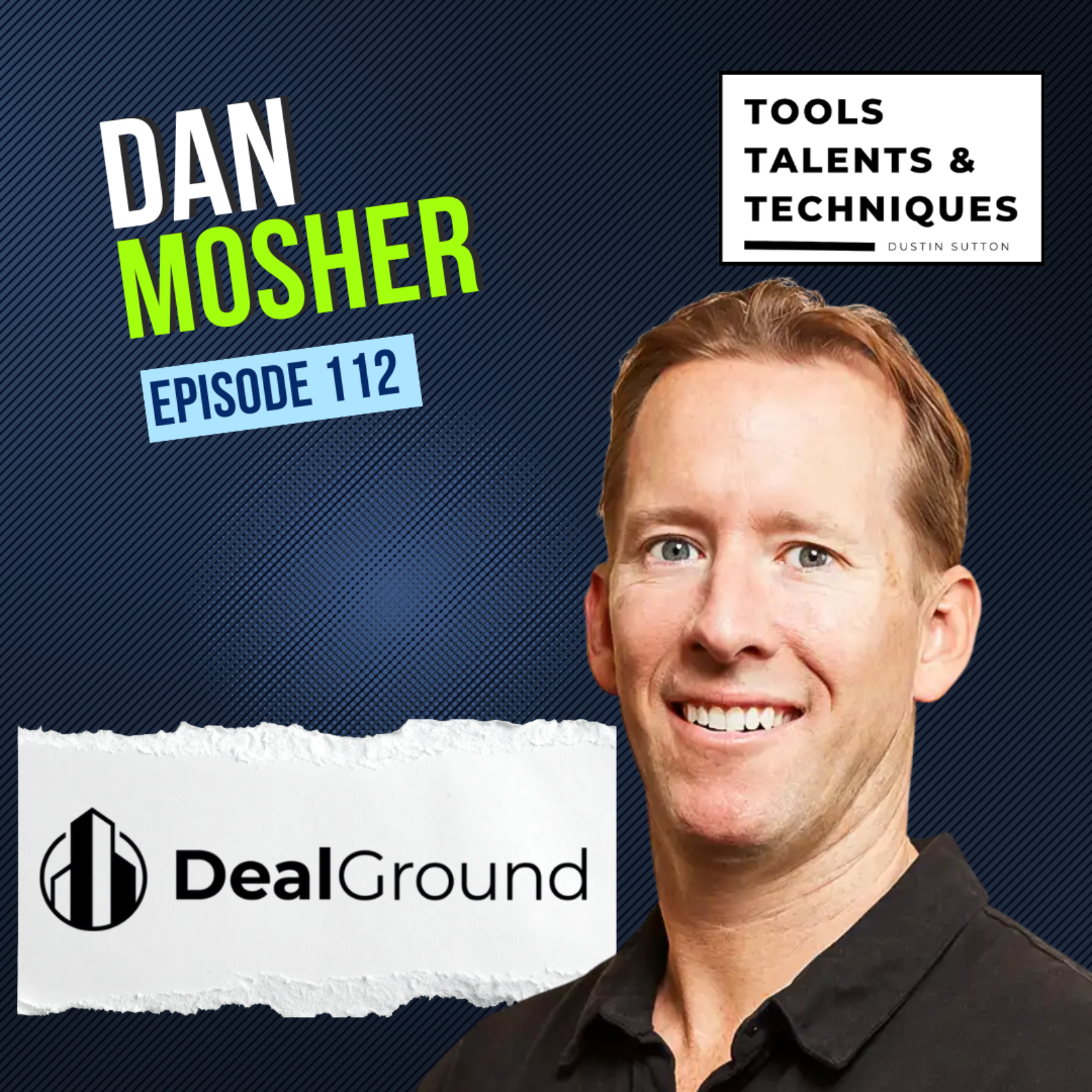
Ep. 112 | How AI Is Disrupting Commercial Real Estate | Dan Mosher, DealGround






🏢 AI Is Disrupting Commercial Real Estate. Here's What That Actually Looks Like.
Dan Mosher has been early to almost every major tech wave of the last 25 years. Food delivery. Electric vehicles. Programmatic advertising. Now he's setting his sights on commercial real estate, and the timing could not be better.
Dan is the CEO and co-founder of DealGround, an AI-native data platform that combines fragmented property and market data into one searchable system spanning 62M+ properties. Before launching DealGround, he led the merchant team at Postmates through its $4.4B acquisition by Uber and served as SVP/GM of BrightRoll Exchange ahead of its $640M sale to Yahoo.
In this episode, Dan and Dustin unpack how AI is reshaping the way brokers access data, build pipelines, and close deals, and why the brokers who adapt fastest will have a massive competitive advantage.
🔑 What You Will Learn
- Why being early is both a superpower and a liability, and how Dan navigated both
- How DealGround is stitching together siloed CRE data into one AI-powered interface
- Why the new crop of brokers is the catalyst for industry-wide adoption
- How AI agents can now write outreach letters, pull ownership data, and build prospect lists in seconds
- Why curiosity is the most underrated skill in the AI era
- How to make yourself a 10X employee using the tools that are already available to you
🕐 Episode Chapters
00:00 Making Yourself a 10X Employee with AI
00:39 Welcome Dan Mosher, CEO of DealGround
01:29 What DealGround Is Building and Why
02:02 From Morgan Stanley to Web 1.0 and Beyond
04:44 Always Early: Lessons from Webvan, EVs, and Mobile
06:05 BrightRoll and the Birth of Programmatic Video
09:53 Postmates and the Restaurant Delivery Revolution
16:30 What Stays Constant Across Every Stage of Growth
20:29 Why Commercial Real Estate Was Ready for Disruption
22:46 Stitching Together Siloed Data with LLMs
26:17 How Dan Validated the Problem Before Building the Product
31:36 DealGround vs. the Incumbents: The Clean Sheet Advantage
35:45 AI Certifications, Curiosity, and Cross-Industry Thinking
39:44 Making Brokers 10X More Efficient 41:39 How Dan's Team Uses AI Across Sales, Product, and Engineering
46:52 Democratizing Access to CRE Data
48:18 Parting Words: Build Your Skills, Embrace the Tools
🔗 Connect with Dan Mosher
LinkedIn: https://www.linkedin.com/in/danmosher
DealGround: https://www.dealground.com
🎙️ About Tools, Talents, and Techniques
Hosted by Dustin Sutton, Tools Talents and Techniques is a podcast for founders, operators, and professionals who want to go deeper than surface-level success stories. Every episode unpacks how high performers think, decide, and build things that last.
📲 Subscribe and leave a review if this episode brought you value. 🌐 toolstalentstechniques.com
Dan Mosher (0:00): Learn how to use them, take those courses that are available online, build your skill set so that when you're walking into that next opportunity, you know how to use AI and make yourself a 10x employee no matter what field you're in. And if you can do that, you're gonna be super valuable in this new paradigm. Part there's always gonna need to be a human to harness these tools and get the most out of them.
Dustin Sutton (0:39): Well, here we are. Welcome to the show, Mr. Dan Mosier, CEO and co founder. Yes. Well, listen, let me allow you to introduce yourself.
Unknown Speaker (0:48): Could you give us a quick thumbnail on who you are and a little bit about your company?
Dan Mosher (0:52): I'm Dan Mosier. I'm the CEO and co founder at DealGround. It's a company that's doing real estate data. We're kind of using AI to give data to brokers in a way that they've never been able to access it before. We're disrupting the industry.
Dan Mosher (1:06): Commercial real estate has been an industry that's operated a certain way for decades. And now with the advent of AI and large language models and now agents, we're able to help brokers and real estate professionals. I could be because it could be investors or help we're helping them take a different approach and really make data their asset. And so we're been building this for the last year and a half.
Dustin Sutton (1:29): Dan, I've been excited for this conversation. We had our first call when we talked about this and somebody who's been in real estate for a couple of decades now. It's crazy to say that. I have seen so many different areas that are just ripe for disruption and well, thank you for stepping in and taking your talents to this industry and trying to make it better. We talk about where you are now.
Dustin Sutton (1:52): Could you talk a little bit about the disruption that you've had a part in, in the past and coming up to this point? Like where'd you start in your entrepreneurial journey?
Unknown Speaker (2:02): Yeah. Yeah. I started, I went to Berkeley undergrad. I did a business school undergrad at Haas, which is a great undergraduate business school. Got really cut my teeth in finance and then was at Morgan Stanley doing investment banking.
Dan Mosher (2:16): And this is a long time ago. This is like the late nineties. I was able to have a ringside seat for a lot of, you know, kind of the web1.o, explosion and then downdraft, but it was you know, I got to be part of, broadcast.com, which is Mark Cuban's company selling to Yahoo, Netscape selling to AOL as part of the finance you know, the a teams that did those deals. And then I very quickly went and joined a company called Webvan, which was one of the poster children for the web1.o, which was really gonna disrupt the grocery industry and do delivery of food to you know, via the Internet and via delivery people really before its time. You know, we we raised a billion dollars.
Dan Mosher (2:57): We went public. And then in two years we went chapter 11. And so I was able to kind of observe that. It got to go on a roadshow, like a IPO roadshow. You know, one of my first things out of college, which was really cool to be part of that.
Dan Mosher (3:10): And that was kind of the first disruption that I at least witnessed. And it didn't even know it was a little early. And now Instacart is obviously thriving, but we were a little early in the 1999, 2001 period. I went to a company called VeriSign, which was a security company. They had done a lot of internet security and they had acquired companies in the domain name space, network solutions.
Dan Mosher (3:33): Now that business is still going well. It's kind of the .com.net domain name business. We made it a lot of acquisitions. And then a group of us left that company and started a mobile company. First called Frango and then called Admarvel.
Dan Mosher (3:46): So kind of my first formation of a company was, you know, 2007. And the company ended up being an advertising play and, you know, really, you know, had an acquisition, so had a positive outcome. But it was a, you know, relatively small entity. So I got to kinda see mobile early days. This is like pre iPhone mobile, and see kind of how that industry was going to change.
Dan Mosher (4:13): And then I actually joined an electric vehicle company, worked with a guy that I had worked with at, at Webvan. One of my mentors, a guy by the name of Kevin Zinger. And he brought me into a company called Coda, which was going to be a battery operated vehicle. We built a vehicle with the help of some Chinese partners. Actually I got a vehicle kind of ready to go, but it was early for electric vehicles.
Dan Mosher (4:38): It was 02/2010. Yeah.
Unknown Speaker (4:41): I'm sensing a theme. You're you're always early.
Dan Mosher (4:44): Always early. Yeah. You know, there's an investor that I really like who says like, when you're early, you're wrong. So it's you know, even though, you know, electric vehicles, you know, food delivery o one zero o, electric vehicles o nine, you know, and it was you could tell it was coming, but at that time, you know, consumers just weren't ready for it. The charging infrastructure hadn't been built out.
Dan Mosher (5:05): I mean, we were a new car company and trying to build a car you know, you go to do a crash test. You know, I think people don't really understand how difficult I mean, you know, kudos to Tesla for doing this. The the one company that's been out there as a new car company that's been really successful. I mean, you because if you crash test a car and you the intrusion is incorrect into the passenger side, you gotta go back to the drawing board and you gotta totally retool your manufacturing facility to then and then you could be nine months delayed based on one test result. And when you're in venture capital backed company, nine months is a killer.
Dan Mosher (5:40): And that kind of thing that took us out of the market and that company again, you know, so I've had a lot of failures in my career. I think I've learned a lot from the failures, I've also, I've also, haven't been afraid of failing. I think that's another thing that, you know, a lot of people don't appreciate about, I think Silicon Valley in general is that there's a culture of failing is okay. You know, people are trying, people are trying new things. I failed at a bunch of different things.
Dan Mosher (6:04): And then luckily I got to join a company called Brightroll, which was a video advertising platform. And again, transforming the way video advertising was bought and sold. You know, when I joined in 2011, video advertising was basically built, you know, bought, you know, hey. I wanna advertise on CNN. I wanna put my pre roll video in before a CNN news segment.
Dan Mosher (6:26): And I would basically contract with CNN and then I would go talk to Home Depot and get their advertising and put it there. It's kinda like an ad network type approach. Whereas we built the first exchange for video advertising. So we would go get pockets of inventory like Angry Birds and other things and say, hey, Angry Birds, we can put a video ad in between levels of the game so you don't have to charge your customers anything. You can have them have a free experience and they're going to basically watch ads between level one and level two.
Dan Mosher (6:55): And that was a huge benefit to the app providers because they could provide a free experience. And then obviously the advertisers are able to basically put their in you know, their, ads in and sequence it to the right person as opposed to just buying on CNN. They could say, actually, I wanna, you know, have my ad be seen by someone 25 to 40 years old who's a male, and then just put me wherever that person is. I don't care what, you know, app it's on necessarily. And so that was the first kind of attempt at programmatic advertising in the video space.
Dan Mosher (7:30): So that was new. And then we ended up getting acquired by Yahoo. And this was kind of the end of Yahoo's long tenure as the, you know, king supreme in Silicon Valley. They that had kind of fallen quite a bit, but I was able to run not only the video exchange that BrightRoll brought to bear, but also the, Bright Media exchange, which was a display exchange that they had bought in 2009. And so that actually ended up being a pretty big revenue source for Yahoo up until the time that that the company was sold to Verizon, which was 2016, 2017.
Dan Mosher (8:08): And, you know, they merged it with AOL and that didn't go so well. And they've been sold a couple of times, but now they're owned by a private equity shop. But that was again, interesting, like, you know, joining Brightrole it was about 80 people when I got there. We got up to about 400 people and then sold to Yahoo and suddenly we're part of this 9,000 person gigantic company, and then sold that to Verizon, which was again, and then, you know, 50 to a 100,000 person company. So being able to see different levels of growth and how different kinds of companies operate both, you know, four people sitting around a table where that's it and a 10,000 person large enterprise that's been out for quite some time.
Dan Mosher (8:51): So been able to kind of see some of that. After the Yahoo experience, I joined Postmates, which was relatively early in food delivery, say again, transforming the restaurant space and saying to consumers, you can order any restaurant food on your phone to be delivered. You know, back in the day, you could really only get pizza delivered and then you would maybe Chinese food. And then suddenly we opened up every restaurant. And then we would, my job was to basically partner with the restaurants and sell, say to the restaurants, Hey, you got to make your menu available to Postmates consumers.
Dan Mosher (9:28): They want to buy it. We're going to, we're going to send the courier into the restaurant and pick up the food. We want to plug into the point of sale system so that you can see the order, make the order. And so when the delivery guy comes, you're just handing them a bag and they're walking out the door. Because when I got there, the couriers were basically like looking at their phones and ordering when they got to the restaurant, which was obviously very inefficient.
Dan Mosher (9:53): And it took a couple of years for the restaurants to finally accept that this was going to be a new paradigm for them. And now if you look at like, you know, guys like Chipotle, you know, 40% of their business is digitally. And that was nowhere, you know, in 2019, 2017. And now is, you know, with DoorDash and Uber eats, which, you know, postmates, you know, eventually we sold it to Uber eats. Now those are gigantic, you know, multi, 100, you know, $100,000,000 companies.
Dan Mosher (10:24): I mean, it's kind of a, it's a fact that this is now just a way that it, that people order their food and every single restaurant in business, whether you're Chick fil A or the small mom and pop sushi place on the corner, you have to have a delivery strategy, to be in this, to be operating in 2026. So I've been able to see kind of a lot of different things. And that kind of brought some of that ethos. And then I was at a company called Presto after Postmates, which was really changing the way that people were going to order in the drive through. So instead of ordering from a human, they're ordering from an AI voice bot, and that AI voice allows the restaurants to lower their the number of staff they have.
Dan Mosher (11:08): And it also allows them to generate more revenue because the AI is always gonna ask for some type of upsell. Either, hey, do you want cheese on that? Do you want an extra fry? Do you want an extra Coke? And whereas a human gets kind of sick of saying that and sick of getting told no by their customers, AI never gets sick of saying anything.
Dan Mosher (11:27): They'll say, they'll repeat the same thing relentlessly, which is something, you know, the beauty of it. And in some cases it's more accurate and can be faster than humans. And, you know, I think that'll be, it hasn't really taken off yet, but it was another thing there. There's a 130,000 drive throughs in The US and the thesis was the vast majority of these are gonna operate via AI in the future. Maybe it's not 2026, but maybe 2036, who knows?
Unknown Speaker (11:54): Well, what if,
Unknown Speaker (11:55): and then
Unknown Speaker (11:55): real quick. Yeah. I want to, because I want to make sure I put a pin in this. I don't want to forget this because it is amazing to me when you think of things that you're like, yeah, that makes sense. And yeah, of course, you know, just like the, what you said about the delivery and being able to order ahead of time instead of when the delivery person came in and ordered it in the store.
Dustin Sutton (12:17): But from getting from a concept of like, yeah, we should do this. And like, this is how it should work. And actually making that happen is so much harder in anything than most people think it is from the outside. So I just want to make sure when you said that it's like, oh yeah, of course you'd order on your phone and go pick it up. But like making that happen, it's not an easy thing to do.
Dan Mosher (12:41): No, no, it's not. And you think about just, I mean, the ordering on the phone, you know, what menu are you ordering from? Does that restaurant now the restaurants change their menus all the time. And so now you've gotta propagate that. If I don't have a chicken sandwich available because I'm out of chicken, I gotta not Like someone walks in the store, I can just tell them, you know, I don't have that anymore.
Dan Mosher (13:02): But if I've got all these different services online and I've got thousands of customers looking at that menu, I need to actually be able to tell that consumer, no, that item is not available in real time. I just ran out of something. And so we gotta have the store clerk basically say, oh, 86 this item in the register and propagate that out to everybody else. So just that itself. I mean, there's a myriad of different things, but, and then how do you see, you know, how do you summon the delivery person to go to that store in their route?
Dan Mosher (13:31): You know, there's a route management thing, which is complex, but I mean, Uber did a great job of that obviously in ride sharing as well. But But this is a little bit different because it's point to point. It's not just go pick up this person and take them to their destination. It's go pick up this food or maybe three different food items from three different restaurants and drop it off at these three different, you know, recipients. And then we started with, on the restaurant side, we started with tablets.
Dan Mosher (13:55): That was kind of the right, you can never, you know, how do you eat an elephant? One bite at a time. Well, we're not going to go into the point of sale right away. That's pretty complex. Let's create an application that goes on an iPad, deliver the iPad to the restaurant, and just say, all you need to do is turn this on, plug in, and the order will come up in the iPad.
Dan Mosher (14:16): And it'll say, hey, Dustin wants a burger, fries, and a Coke and the courier's gonna be here at 11:30AM to pick it up. And so that restaurant then could see that in the iPad and basically say, okay, confirmed, I'm gonna make that food. And that was kind of step one. And then you kind of get these iPads out there in a bunch of different places. And then you had the problem where the restaurants would have seven different iPads because you'd have Uber Eats, DoorDash, Postmates, Caviar, all these and, you know, smaller players as well, and suddenly you look at you own these restaurants and it looks like a tech store with wires and tablets all over the place, so you're like, okay.
Dan Mosher (14:54): Well, that doesn't make sense. So then people started building that one iPad to rule them all that had all, we all plugged into that one iPad. And then it's like, the next step is I already have this point of sale device sitting here. It's an old thing that's running on Cobalt or something, but how do we get the orders to plug into that system? Because then you don't and then you get do with all the iPads.
Dan Mosher (15:18): And then as the restaurant thinks about reporting and how they do cash management, it's just flowing through their exact same system. So we actually did that first with Shake Shack in, I think it was like late twenty eighteen. It was still early in the process. And I think we were one of the first ones to start plugging directly into the point of sale system. And we knew it was going to be the future, but again, you get one restaurant, you get them to do it.
Dan Mosher (15:42): You do a couple of like battle tested versions, you get it out there. And then you used to go to the other restaurants and you say, okay, well, this is what we're doing with Shake Shack. This is super efficient. We want to work with you and do the same thing. And then you go through a technical deployment process with each and every restaurant.
Dan Mosher (16:00): Now, luckily, a lot of them had the same point of sale systems, but everybody has their own menus and their own nuances. You So got to work through that. So when you're talking to Chick fil A or McDonald's or Burger King, it's a whole separate process. But once you get a McDonald's online, it's like, okay, boom, now I've got 15,000 restaurants that I could light, you know, assuming I've got the courier capacity to go to all those places, but I've got 15,000 restaurants I can light up in an instant once you do that, which is amazing, but you're right. It takes a long time to get there, but you just, you know, put one foot in front of the other and keep marching.
Dustin Sutton (16:38): So a couple, I want to, I want to talk about deal ground. I want to make sure we have enough time to talk about that because I'm deeply interested in that. When you mentioned, okay, you raised your company raised a billion dollars, two years later, you know, chapter 11, you know, you start over, you start doing and you mentioned going through, you know, been, being with four people and then being seven, you know, thousands. Was there anything that you learned personally about yourself on how you deal with certain issues, like how things need to change versus how they stay the same, regardless of, what type of environment you're in? And that's kind of a deep question, but it's like when I see the thread of people, you're like, Oh, now you're over here.
Dustin Sutton (17:24): Now you're over there. Sometimes you have to navigate these different situations, but are there anything that stood out to you of like, Oh, this is way different than that?
Dan Mosher (17:35): Well, I mean, I think you just got you have to look at every situation. And I think one of the things is like, you know, have a kind of a mantra for yourself. It's like, no matter what the situation, what kind of environment you're in, it's like mine was always like, first I wanna be transparent and like tell people what I really think. And sometimes it's kind of like the brutal facts. You know, there's a great book by Jim Collins who wrote Good to Great, which is one of the quintessential books in like the aughts, but it talks about confronting the brutal facts and not being afraid to talk about the brutal facts of a business and how the business is going.
Dan Mosher (18:09): And kind of if you're able to, in a non emotional way, discuss the brutal facts, discuss people's strengths and weaknesses with them, and then be transparent and say like, okay, here's where I'm falling down. Here's where I could be better. Here's where the company is falling down. Here's the great things we're doing. Here's the places that we have to be more resilient and improve ourselves.
Dan Mosher (18:30): No matter what environment you're in. I would say that, you know, being straightforward, having integrity, you know, cause you're always going to deal with what I found is that you build your competencies. Like what are your skill sets that you want to build? It's like mine started in finance and then I kind of moved to more like business operations and like P and L responsibility and then kind of to sales and understanding how sales organization is built. So you build those competencies, but then you also build your relationships with key people along the way.
Dan Mosher (18:59): And you're going to see these people again and again, I've hired the same people at three different companies, four different companies, and you work with people, they know who you are. I've also gone with certain people that I've trusted and believed in. And so you just kind of conduct yourself a certain way and you have a certain philosophy. You gotta be clear in your communication of like where we're going to go. Like, okay, this is what is critical.
Dan Mosher (19:24): This is where we're going as a company. This is where we're going this quarter, this year, what have you. And if you do that, no matter what environment you're in, it's going to lend itself to that type of thing. I mean, there's obviously differences in the larger environments. You have to deal with more political stuff, like people arguing over fiefdoms and such, but you don't really have to deal with that in smaller companies.
Dan Mosher (19:45): So you got to be kind of aware of some of those things, but at the same time, as long as you're true to yourself and have your own thing that you bring to the table and you're consistent and you consistently show up, you can navigate any kind of situation, big or small.
Unknown Speaker (20:00): I love that. That's a gem. Thank you. Glad I asked. I asked.
Dustin Sutton (20:03): Okay. You coming from a finance background and you being early for so many different things that are game changers. What is it that you look for in where you're going to go next and what's ready for disruption? I think that leads to where you are now with DealGround. What was it that you saw in commercial real estate that you were like, I'm going to jump in here?
Dan Mosher (20:29): Yeah. Well, think the one of the biggest things is the size of the space, right? You always want, you know, venture capitalists talk about TAM or, you know, total available market. And so you wanna look at anything, whether it be food delivery or, you know, electric vehicles or, you know, commercial real estate is the fourth largest asset class in The United States. And so you look at the size of the market and what's the opportunity.
Dan Mosher (20:53): What's the, I think there's, you know, 500,000,000,000 of transactions every year in the commercial real estate space. And so that's one of the first things you look at. Okay. Is this a big enough market where there's enough, you know, kind of totally available and that you can build a nice, there's a bunch of little nice businesses going to be built in there. And then is there some new insight that has presented itself?
Dan Mosher (21:13): It's like, what's the new insight? Well, in my case, was the large language models and the advent of ChatGPT when it came out in the fall of twenty twenty two and kind of looking at what is these large language models, what are they really good at? Well, they're really good at assimilating a lot of different data sources and putting it in a common user interface, in a common way that because at the end of the day, people want insights, they want answers. And if you've got this new tool that allows you to generate those answers, okay, so where are the fields where this is gonna be the most valuable? And I looked at commercial real estate and luckily I had a friend that had been in this space for thirty years.
Dan Mosher (21:54): So I'd been had an internship in a commercial real estate firm when I was in college, so I'd kind of been familiar with it from the outside. And I also understood that it's a very siloed industry. The information is in different pockets. These brokers traditionally and the investors, you know, dealt with information asymmetry. Know, certain people have great information, other people had less information, and that information was currency in transactions.
Dan Mosher (22:21): Like, oh, I know what that guy, I know that In N Out is paying $35 a square foot. So when I'm negotiating over here, that's an advantage for me because I know what the precedent is. And that's not a public, it's not a stock exchange. Right? These are all private transactions between a landlord and a tenant or a landlord and another buyer.
Dan Mosher (22:42): And so all of these are information that's relatively private, but then it there's pockets of it that become public. And so the insight was is, wow, with these LLMs and AI generally, you can take an industry that had been siloed, fragmented for years, stitch it together and provide a interface and an insight capability to brokers and professionals that they hadn't been able to get previously. So it's like, okay, well, if we can do this and stitch together these different data sources in one place, make it easier, and you kind of look at what's the workflow today and is it broken? That's another good question. You know, what are people doing today and is it fundamentally broken?
Dan Mosher (23:23): Do they complain about it? Well, they're actually in five or six different tabs of their browser, five or six different systems that are different, that are not connected, and they're kind of hunting and pecking. And at the same time, everything is about getting the commission. These guys want to get the deal done because they're not typically getting paid a salary. They're eating what they kill.
Dan Mosher (23:45): They're making the money on their commission only. And so time is their most critical resource. They wanna get those deals done and they wanna maximize the amount of throughput they can get with the hours they've got in the day. And if they're spending all their time running through secretary state filings, trying to find the owner's name, you know, oh, it's not the owner, it's the owner's daughter. How do I get their phone number?
Dan Mosher (24:09): Now I'm going to PeopleFinder. Now I'm going to ZoomInfo. It's a lot of their time as we investigate and I unpack this as I was evaluating it, I could see so much time was spent on this administrative function. And where at the end of the day, these guys are really sell sales guys at their core. They're selling a proposition of here's a great property, here's the cash flow characteristics, here's why this is gonna be a great asset, this is why there's gonna be a great return on your investment, And they're selling that to a guy who's looking to buy.
Dan Mosher (24:38): They're selling their services to somebody who's thinking to sell. They're like, I wanna be your listing agent. I wanna work with you. You're a landlord. I'm gonna help find tenants for you.
Dan Mosher (24:48): You're a tenant. I'm gonna help you get in 10 additional stores. That's really a core of sale position, which I understand intimately. And it's like, how can you spend less time on the administrative piece and more time developing relationships and doing the actual selling? So I knew that, again, we got a lot of wood to chop, but I could tell that this is a big enough space and it's a big enough problem that if we could build something that was compelling, we could make a big impact.
Dustin Sutton (25:16): Yeah. And to your statement of, know, if it ain't broke, don't fix it. I always felt, especially in commercial real estate, that there's a feeling for me at least, like if it ain't broke, don't fix it. But if it's broken, but it still works for the people that are still making money hand over fit. You know, like the property values just kept going up and the people that are in control don't really like, why why would I change?
Dustin Sutton (25:45): I mean, maybe not making as much as I could, you know, so there's a, there's a difference there. Like, why is it, is it worth actually fixing? But now because of everything that's happening in the market and recently I agree. I think this is a great time to be introducing new and novel solutions. But to your point about the research that you did, can you walk me through that?
Dustin Sutton (26:05): Like what you actually did to, you know, whether it's interview brokers or take a survey, like how did you actually go through that process of finding out where you should aim your arrow?
Dan Mosher (26:17): Yeah. So I went through and I had a couple of different things that I was evaluating in terms of when I was looking at my next chapter in kind of the fall of twenty twenty four. And as I looked at this space, I looked at my network, you know, like I've been worked with commercial real estate brokers my whole career, typically helping me find, you know, offices and so forth. And so I went through my whole network and did a series of interviews with them and basically said, Hey, what's your biggest problem today? Walk me through your workflow.
Dan Mosher (26:50): Like if you're gonna try to find a new client, like let's say you're gonna go get a new listing. How do you go about doing that? Let's walk through that process and kind of almost like shadow them and have them articulate where they put their effort and articulate what the problems were with that. And then after a little bit, kind of come back and say, okay, well what if we had something that could get this and this data in one place? You know, in our case, it's all the offering memorandum data, which is kind of the lease characteristics, the lease term, the rent that they're paying, coupled with the title data, which is all like the last transaction.
Dan Mosher (27:24): And then also who owns that building, the name and phone number of that. You know, the the key is to not say too much early on about what you think you wanna build because then there people are gonna be like, oh, yeah. That sounds great every time. So you have to actually just ask them where the problems are and where the problems sit. And once I talked to, you know, three or four different people, I had an inkling and I ended up talking to, you know, 15 of them, folks that I knew and folks that were friends with my co founders, and all of them had a super different tech stack.
Dan Mosher (27:59): Right? They all had five platforms, but the platforms were always different. You know, usually like CoStar is like the one core one that they all have, but the rest of the amalgamation is very different, but they all complained about switching between the platforms, not sure how quickly to get access to information, how they did something was very different person to person, but none of them had found that perfect algorithm to execute. And so that was kind of the clue of like, okay, here's an issue that is actually a broken workflow and everybody does something different. But you're right, but there isn't this whole like, they come back and they would say, I'm actually making pretty good money.
Dan Mosher (28:44): It doesn't really make sense. It's kind of laborious, but at the same time, it's what I've done for decades in some cases. But I knew that, you know, I hadn't had enough conversations with like the restaurant owners back in the old days where they would say, no one's gonna order food this way or it's always gonna be a really small portion. You know, the fries are gonna be soggy. So there's always gonna be those kinda naysayers, and so you have to filter that out a little bit because the people that and then you talk to some of the up and coming brokers, like there's another set of guys, this new crop that's coming up.
Dan Mosher (29:16): And it's just like in the food delivery space, that was the millennials that were using their phone for everything. And they were on Instagram twenty four hours a day. They're gonna order food and they're gonna be the catalyst for the industry to change. And I think same with commercial real estate, you've got these new brokers or new, you know, earlier in their careers, they're looking for an edge, they're looking to get ahead. They don't care how it's been done for decades.
Dan Mosher (29:42): They wanna leapfrog ahead, and they feel like AI gives them the license to do that. And if they can start to outperform the three Martini lunch crew, they're gonna do that. And so once you start arming the upstarts, then the guys that have been around for a while are going, wait a second, I don't want these guys to pull the rug from under me. I wanna figure out what they're doing too. So then it starts to kind of become a perfect virtuous cycle.
Unknown Speaker (30:09): Yeah. You know, that makes a lot of sense. And I think a lot of these things, it's weird until it's normal. And then it's like, yeah, of course. You know?
Dustin Sutton (30:17): And I think that's where this all go. But I love the fact of focusing on the younger folks, brokers that are open to doing things a different way that aren't stuck in their ways that are like, Hey, I got to figure this out. I'm trying to make some money. How am I going to do it? And if you give them that tool, then the other people will catch on.
Unknown Speaker (30:35): Yeah, that's great.
Dan Mosher (30:37): Yeah, for sure. And like, and you know, they're starting their careers. They don't have access to the same data that somebody does. That's been in the industry for, you know, fifteen, twenty years. So it's like, here's a unique dataset at its very core.
Dan Mosher (30:50): That's not available in the title data and it can kind of help you bootstrap and get up and running faster and you don't have to necessarily just collect data for three years. It's like, let's present you not only an interesting dataset, but a way to get access to that data that's unique because you've got these large language models and systems that can go into a labyrinth of documents and pull out facts that matter for that particular deal to bring to fruition. So there's a couple of different new elements to this that help them kind of get their dataset up and running faster and then access insights from that dataset that they would never have been able to get before, unless they were studying and doing research all day.
Dustin Sutton (31:35): So you're right. There are a lot of different tools out there, right? You mentioned, and platforms, you mentioned CoStar, you got Credxi, you got, there's other platforms out there in your mind, like in what you're doing, is there an advantage that you have on being relatively new and early and seeing this with fresh eyes, like being nimble and being able to adjust quick? Cause AI is changing so fast. I'd love to hear your perspective on advantages that you have that maybe a larger organization can't change that quickly.
Dan Mosher (32:08): Well, yeah, I mean, certainly have advantages because we're starting the way we're starting and the way we're going about this. I mean, obviously we're a small company, so from a scale perspective, we're still early on in the development process, but you think about these bigger companies, they've got, they've been around there, in some cases, forty years, they've been doing things a certain way. Anytime they see these new technologies, they have to figure out how to integrate them in with their current business model. Right? They can't, like we could start this from like a clean sheet of paper approach and say, how would we do this if we were going to start fresh from day one and give people exactly what we think they want?
Dan Mosher (32:46): We didn't have to bolt on an AI solution to an existing product. The product was AI enabled from day one natively, which gave us a huge advantage. And it also gives us the advantage, you know, now as we're thinking about like Claude and these MCP type servers where you're actually just using agents to go in and access the data itself, we can now build out that kind of capability where someone could just go into Claude or ChatGPT and type in commands like, hey, find me every multi tenant retail building in Columbus, Ohio, give me the name of the owners and write me a cover letter to all 20 of those owners and just output it. And AgenTex system, can now look into the core data from DealGround and then present answers to those brokers. So we have the ability to build exactly a new paradigm because we've started fresh and started this from a clean sheet of paper.
Dan Mosher (33:49): Whereas I think the incumbents, they have a set of advantages. They've got a deep customer basis and so forth, they have Wall Street to, they've got quarterly earnings to think about. They've got growth that they've gotta show on their existing business. They've got existing customers on existing contracts. They've gotta cater to those customers.
Dan Mosher (34:10): There's this whole, they wanna, you know, obviously they're gonna try to innovate as well, but it's gonna be more in a bolt on environment, whereas we're gonna say, look at the way this is happening. How do we want to build this? You know, we have customers now coming to us and saying, hey, actually, you know, I've got my own systems. Your data model is really interesting. Way that you get access to these different pieces of data, the way that you extract it.
Dan Mosher (34:33): We'd like that data just in our systems via API. And we say, sure, we can do that. Like this is where we'll do our data extraction, we'll harmonize the data, we'll assimilate it in one place, and then we'll push it into your systems as well. I think some of these guys that are more like have been in the industry for a long period of time are probably not as willing to investigate other business models as well, which gives us an advantage. So we're listen, We're gonna be there how you want.
Dan Mosher (35:00): Do you wanna use our interface, which is a more of a traditional map based interface that you can is simple and intuitive and everything's in one place as opposed to five different systems? Great. Do you want to use an agentic solution where you're just typing in commands into a ChatGPT interface and getting an output? Okay. We'll do that too.
Dan Mosher (35:20): Or do you want it you've got your existing system, which is maybe an existing CRM or existing data system. Do you want us to just push the data into your system so that your brokers don't actually even have to log out and change what they're doing? They can use the exact same systems. They're just using deal ground data. Sure, we can do that.
Dan Mosher (35:38): So we can be a little bit more open and flexible and kind of work with the customers where they are.
Dustin Sutton (35:44): You know, I don't think I've mentioned this to you before, but a couple years ago, I took a course through the Berkeley Haas School of Business for my AI certification. And just because I'm interested in it, you know, I've always loved tech and, you know, I've been interested in AI since, you know, watching 2,001 Space Odyssey, you know, years ago. But I've always been like interested in it. And so when I saw it coming, was like, oh, I wanna take a course on it. And one of the most beneficial things of that course, I mean, yeah, was the education, but also being around all the other people.
Dustin Sutton (36:16): I mean, was course education, but seeing all the other people from the other industries, whether that be healthcare, finance, I like that you got me to say finance. I used say finance, but I like finance better. Education, like there were just so many different people that were trying to solve a different challenge or trying to overcome a different challenge or problem. And it just sparked all of these ideas of like, oh, well that is similar to this in commercial real estate and maybe this could be done better or faster with this. So that's one of the things that I think is so special about what you're doing and coming into this industry because you have that experience from all those other companies that you've been a part of, and now you're bringing all of that knowledge and insight into how you're approaching this.
Dustin Sutton (37:03): Yeah. I just think it's, I think that's a special part of your story and why, and why this is why, why you're going to be very successful.
Dan Mosher (37:11): Yeah. Well, we're hopeful, man. And I think it's a good combination of, you know, I've got a lot of business experience. I've seen different movies before that played out in this way where transformation was was coming in and how do you execute that? How do you bring people along and and educate them that it's it's safe to go in the water?
Dan Mosher (37:28): Like, it's safe to try this type of new paradigm, this type of new system. And then we also have, you know, my co founder's obviously very deep in the commercial real estate space. So he understands the, you know, the pains and the things that they go through every day when they wake up and he can think about how does this feature gonna play? It's like, oh, well, guys really care about this and this and this data point when that kind of thing comes along. Or it's like, how do we get a better look into the ownership data?
Dan Mosher (37:55): It's like, oh, well, if we use this address that they filed that they used to receive their taxes, that's actually another good indication of all the different entities that are connected to that LLC or what have you. So there's all these unique insights that somebody being in the space also brings. And then I've also brought in folks that I've worked with on the technical side who have built large systems before and were helpful to us to adopting really early, like okay, now Claude code is here and you can build most of the coding can be done by Clog or Cursor or what have you or Codex, and the engineers are now becoming editors, not code writers. And that's really just changed in the last six months. So it's having enough people that are senior enough to have seen this before, but also can adapt really quickly.
Dan Mosher (38:47): It's like like the code piece came online, you know, end of last year, and we tried to embrace it as fast as possible because we knew it was gonna make a single engineer operate like a five or 10 X engineer. And so now I think a lot of people are adopting this kind of stuff, but it's about speed to adoption and leveraging the new tools and being able to see that. And then, yeah, me bringing in other things from the, you know, business world to say, how do you go about executing in a space like this that's big, but also is somewhat resistant to change? And you have to kind of methodically slowly continue to prove yourself and advance the product roadmap every week so that the customers can see, Oh wow, this is changing. This is getting better.
Dan Mosher (39:34): This is getting better every week. And that shows me that this in a year, I can already kind of, I can draw that line and see that where this is gonna be in a year.
Dustin Sutton (39:43): Well, just like you said that the Codex and the Cloud Code and all those things can make an engineer, you know, five times more efficient because they become editor, like everything you just said. I mean, can be true for what these technologies can do for a broker, you know, and make them five to 10 times more efficient because they have all the tools. So that's, you're doing the same thing. Yeah. It's pretty
Dan Mosher (40:05): cool. It's exactly the same thing. Mean, the sales guys, I mean, I have my sales guys go into Clogd Cowork and say, okay, give me the dossier on every demo I'm doing this week. What is the property that we want to show that person that's going to be most relevant to them? What's the kind of the line of sales that we want to take to them?
Dan Mosher (40:25): Because a lot of these guys are very public in their profiles and what things they're working on. And so as a salesperson, you can come to a conversation with a whole different set of information, not only based on what's on the web, but also having an AI tool go through it and parse it out for you and say, Hey, here are the things that is gonna be most, that's gonna like peak this person's interest the most. Or the other thing we do is we take all of our transcripts and we just push those into some of those tools as well. And then say, okay, give me, you know, you've got hours and hours now of transcripts of us talking to customers. I wanna see the five top product ideas that come out of that.
Dan Mosher (41:05): What are the what are the things that are being repeated by our customers? And then kind of use that to synthesize and inform your product roadmap in a much more data based way. Know, the old ways you did that before. You take notes and then you'd have conversations, but now in every field, you know, whether it's legal, whether it's marketing, whether it's sales, whether it's product, you can now use this and be much more data oriented and actually, and much, and operate much faster because you've got basically a junior employee with you at all times.
Unknown Speaker (41:39): Yeah. And you know, because the way I work a lot with AI, it's not like I have two. I have like three, you know, because I have, you know, Claude, I have, I have chat. I have, you know, I got Gamma. I got, I got all these other go, I have a team of really smart and fast and efficient teammates with me.
Unknown Speaker (41:58): So it's been fun. This has been a wild ride so far with AI.
Dan Mosher (42:02): Yeah. And they're all good at different things too, just like a team where certain people have certain strengths. We can see that as well. Like ChatGPT is very good at rendering a table and kinda keeping track of the rent rolls. Gemini is very good at extracting text from a lot of different type of, whether it's a image, whether it's actual cortex, that kind of thing.
Dan Mosher (42:25): Claude is very good, you know, co work is very good at doing a different set of things. So just understanding the strengths of the models and making sure you deploy them in the way that's gonna be most advantageous to you as an operator because yeah, you got these five different things going out there. You wanna make sure you're giving them the tasks that they're best at and that they're gonna give you the most accurate answers as possible and kinda discerning that and figuring out what is best at what part of the learning that us as users of these amazing new tools have to really get good at.
Dustin Sutton (42:56): One of the things that I think really stands out and I see this firsthand, but one of the biggest things, or characteristics of a person these days with all these tools, that is helpful is curiosity. Oh, you have to like, want to say like, how can I do this better or faster? And let me try this out. Let me try this and doing those different things and experimenting. I feel like that's a lot of the recent, I'll call it the recent success that I've had is because of that.
Dustin Sutton (43:26): Cause I'm discovering these things like, oh, look what this could do. You know, then I'll look over here like, but this can do that better. So yeah, I, I a 100% agree with that. So with that in mind, when you guys are exploring these new technologies or new tools, is there a process for that? Or do you and the co founders, your team, do you just explore?
Dustin Sutton (43:50): Or is there like a specific roadmap strategy that you do for discovery?
Unknown Speaker (43:56): Well, I mean, we have our roadmap, our product roadmap of where we want to go. We have a lot of things that we want to build in terms of the platform. There's, we want to pull other data systems in. Right now we've got title data. We've got the offering memorandum data, we've got all the tenant data in The United States, and now we have all the ownership data as well.
Dan Mosher (44:15): And we wanna bring on, you know, permitting data. We wanna bring on sales data. We wanna bring on, you know, demographic data. And the question then becomes like, once you have the roadmap of items you wanna do, then we wanna create more of an agentic solution. Then we wanna feed the data into a CRM solution.
Dan Mosher (44:33): So you have your core product items that you think are going to be good for customers. And then you evaluate, okay, what's the best way to execute this? You have a hypothesis like, oh, it's going be in this tool or that tool or this way. And you try a couple of different items and see, okay, is that gonna be effective? Is this gonna get us the outcome that we want?
Dan Mosher (44:55): But yeah, I mean, the engineers have been testing Cursor. I've been, you know, then some of them started using Cursor, then we kind of moved to Claude. They're always testing the new tools as well to see if that's going be more effective in sort of building and developing and deploying the code. And then for us on the more business side, it's the same thing. It's like, okay, what are the next generation tools?
Dan Mosher (45:19): Are there tools that I can create presentations with? Are there tools I can create blog posts with? Which ones are the best? Let's try a couple of different ones and let's see what the output is. But you're right.
Dan Mosher (45:30): You have to be curious. You have to be super interested and kind of say like, okay, what are these? What are the capabilities here? And investigate the capabilities and kind of push the limits of those systems. And then it kind of fails.
Dan Mosher (45:43): You're like, okay, that was a little bit beyond where that tool is capable of doing right now, but I can still see that these other items that I did worked, but you're constantly trying to push up against that borderline, which is okay. Was not quite ready to do this, but you always want to be curious about what that is and always want to be testing the boundaries.
Dustin Sutton (46:04): Yeah. All of that is why this industry needs people like you, because this is not an industry that I've seen so far that people like to test new things and try new things, but you need to have people out there that are curious, are not driven by fear, that are like, Hey, let's try this. Let's do this. Because it's those people that are the tip of the spear that are really going to make the difference. And hopefully change the world.
Dustin Sutton (46:34): Like you said, it's such a big part of the economy and the way we live, work, where where we shop, where we like all the things and it's such a big part of it. And so if you can make those and all the lives that it impacts better in any way, I think doing a great thing.
Dan Mosher (46:51): Yeah. And then the other idea is really democratizing access to the data where this data has been behind these firewalls for so long. The more that you can kinda make this data available to folks generally, and then that makes the industry more approachable. You know, like, why can't this be an asset type more like a stock equity that's approachable by a more of like a retail type investor? You know, in the commercial real estate, we have mom and pop investors, but these are typically high net worth individuals and but this has been a space, you know, can you make this investment vehicle more approachable?
Dan Mosher (47:27): Real estate's always gonna be valuable. It's always gonna appreciate in an evaluation of like, what is the real estate? What's the characteristics of it? It really kinda comes down to the cash flow. If we can make it more approachable to people that haven't traditionally been in the commercial real estate space, I think that's another great outcome that we're trying to do is kind of make the information more available, make it more approachable for an investor that may not have ever touched a commercial real estate asset.
Dan Mosher (47:55): Now they can include it in their diversification portfolio.
Dustin Sutton (48:00): Well, we take off, thank you so much for sharing and your time. I love where this is going. I'm so excited to see what this comes to. But before we take off, is there any parting words you want to share with the audience?
Dan Mosher (48:17): Yeah, I'd say, you know, don't be afraid of failure. Get out there and try some things and get out there. Know, basically you are your set of competencies and your relationships. So you can be in your garage right now experimenting with all these new tools. They're very available.
Dan Mosher (48:35): This is a little bit like, you know, the ability the arms race where they're all of those big players that are spending, you know, trillions of dollars to build an infrastructure, they want you to use their tools, they're gonna make it as free as possible. You know, learn you know, learn how to use them, take those courses that are available online, build your skill set so that when you're walking into that next opportunity, you know how to use AI and make yourself a 10x employee no matter what field you're in. And if you can do that, you're going to be super valuable in this new paradigm where everyone's going to need to hire people that can properly heartening. There's always going to need to be a human to harness these tools and get the most out of them. So be one of those that knows how to use them and is a huge strategic asset for your whatever operation you're involved in.
Dustin Sutton (49:24): Yeah. You know, and on that note, I would say one of the local universities that I'm pretty close with here in San Diego that's what the senior leadership is telling the students. The real estate students is like, this is new, the AI, the new technology. You can be very valuable to organization if you know at least the fundamentals and how to use it. Dive in now.
Dustin Sutton (49:51): So I think that's very, very appropriate. So Dan Moser, I am going to include all, all your information and links to your website, your LinkedIn, all that on the show notes. Thank you so much for your time. Really appreciate it.
Unknown Speaker (50:03): All right, Justin. Thank you.